


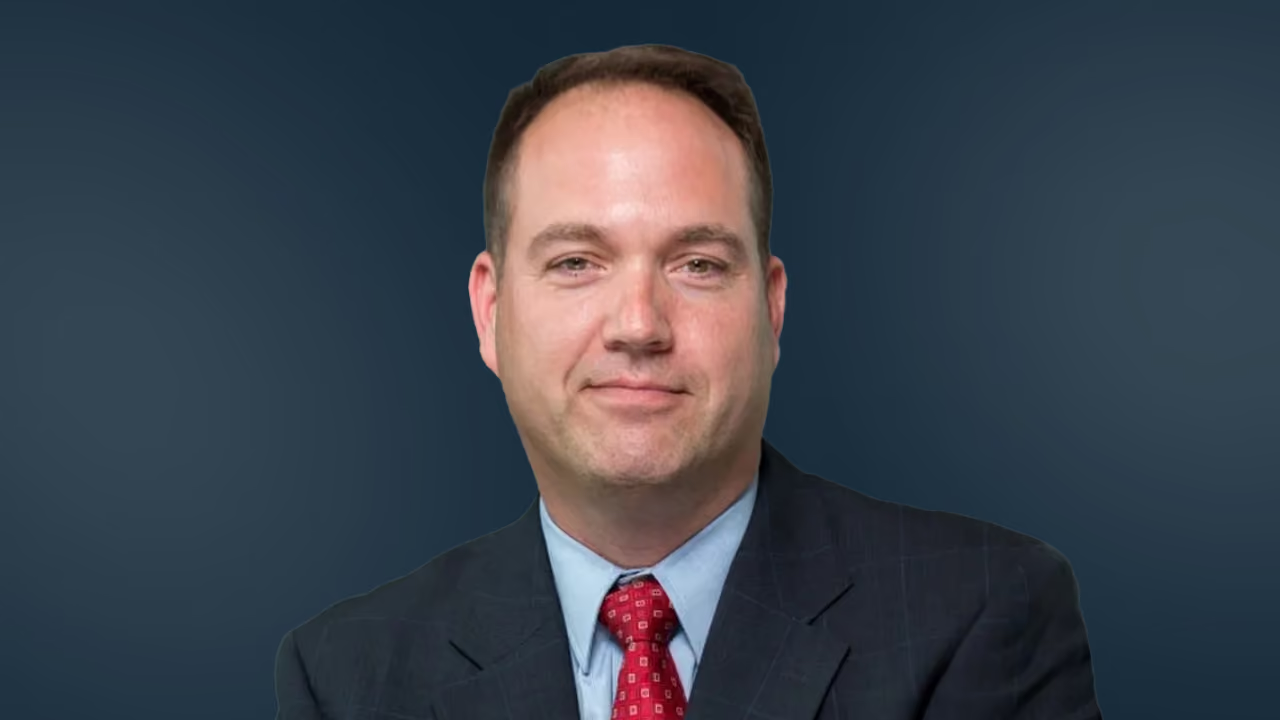

It's not about overbuilding. It's about underserving seniors in the future.

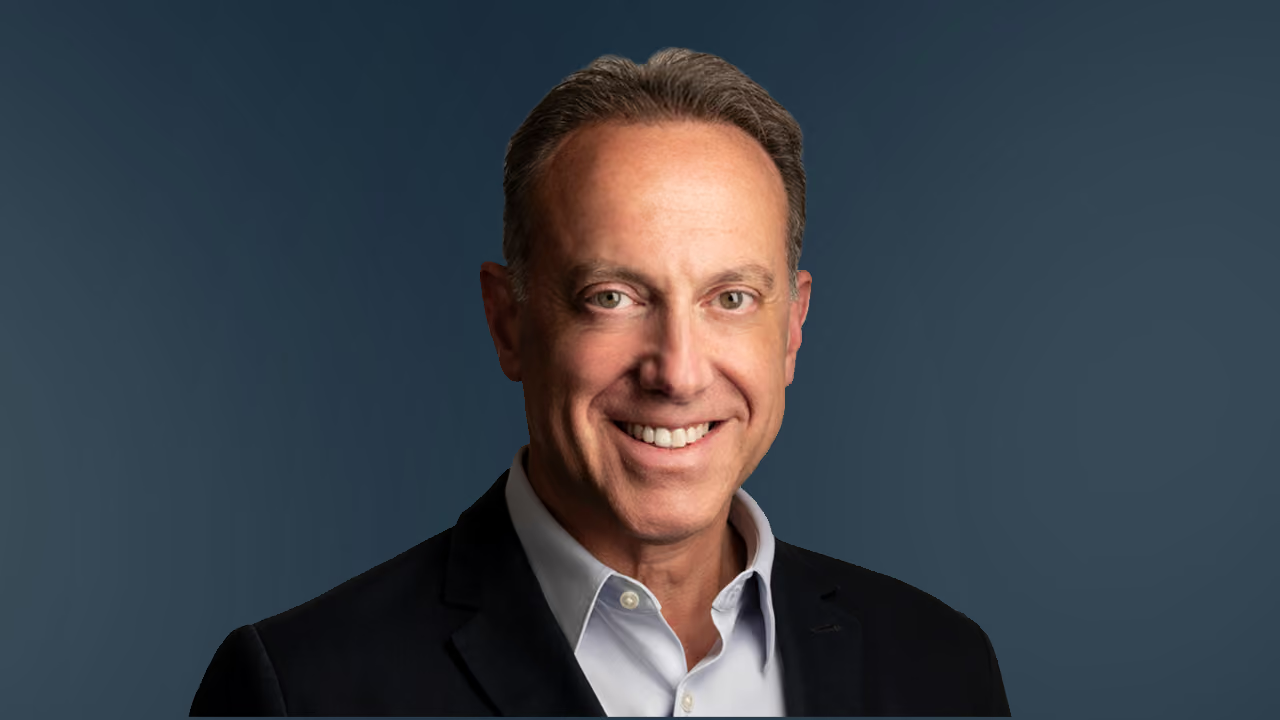
On this episode of VERSED powered by VIUM Capital, Steve Kennedy sits down with James Balda, President & CEO of Argentum, to unpack the biggest forces shaping the future of senior housing. From workforce shortages to access to capital, Balda shares a clear-eyed view of the challenges and opportunities facing the industry today. The conversation explores the growing supply-demand imbalance, with projections showing a major shortfall in senior housing units, alongside rising costs and regulatory uncertainty. Produced by Grit and Gravel Marketing.
00:04 - 04:34
Steve Kennedy
This is VERSED powered by VIUM Capital, the podcast that brings you conversations with the leaders driving change in seniors housing and health care. I'm your host, Steve Kennedy, and together we'll explore the insights, challenges, and solutions shaping our industry.
Well, welcome to the latest edition of the VERSED podcast powered by VIUM Capital. Thanks for tuning in, and I'm very pleased to have James Balda, president and CEO of Argentum, as our guest today, James. Welcome to the VERSED podcast.
James Balda
Well, thank you for having me. I'm thrilled to be here.
Steve Kennedy
So, James, you and I know each other just from both of us being in the senior housing industry for a few decades. And, we've had the opportunity to work together as recently as just this past month. With your team's great work with, FHA Commissioner Cassidy and a group from, you know, your Argentum's capital advisory board.
But for those folks who might not be as familiar with you and Argentum, why don't you give a little bio about who is James Balda and then what does what does Aregentum do for our sector?
James Balda
Yeah, sure. Thank you. Steve, for having me. And thank you for joining that meeting with the Commissioner and looking forward to talking about that and some of the great work that's going on.
So I've been with Aregentum now a little over ten years. Believe it or not, I'm an association professional by background. That's an actual thing. I didn't know it was. I fell into it, working, data entry part time in college. Way back, with the Newspaper Association. When newspapers were were a thing. But just to state in, in the association space, I love getting into an industry, going long and deep on a particular industry and sort of understanding what makes it work and what from, newspapers and the health care and health insurance.
All through sort of, a lot of those public policy debates. And then I found myself with the National Restaurant Association in the middle of the the Great Recession, which wasn't a great time for restaurants. But but the industry came out of that. And then that was sort of how I found myself in senior living.
It was sort of a combination of the hospitality and the health care background. And I received a phone call about this organization called ALFA, the Assisted Living Federation of America. And I said, well, what's assisted living? Right. Everybody has that question at some point, unless you've been in the industry for years and years. And as I learn more about it, I just I became fascinated by it because it was this sort of combination of everything.
It was healthcare, hospitality, real estate. I mean, it, you know, everything sort of all under one roof and and all with an objective of caring for seniors who in some cases our, you know, our most frail population. So, I was fortunate enough to be offered the job and, and, I joined ALFA and we went through a rebranding and changed the name to, Argentum.
People often ask me, well, what what does that even mean? Aregentum? Are you a vitamin company or are you a mining company? What is that? And really, it was, our leadership was looking for something different and unique that sort of called out, what we aspire to be, which is the best possible thing we can be in terms of caring for seniors.
And Argentum is is Latin for silver, which is a standard of measure and certainly a nod to those that we serve. And so, that's that's how we went from being alpha to, our gentium. Our role as an association is really to represent the senior living industry. Be it's advocate, at a national level, certainly with federal lawmakers, but also at a state level.
Now we have state association partners that execute at a state level. Our role is to support them financially and otherwise. And we tend to think about states not as one state, but there's 50 of them that oftentimes deal with a lot of the same issues, whether that's, tort reform or, camera legislation or staffing mandates.
And so how do we think about that from a national strategic perspective and then support our state partners in the best way possible. So that's really our our biggest focus is being an advocate, for the industry.
Steve Kennedy
Thank you for that summary and for emphasizing to just the work you do at the state level. You know, my mind goes to a recent verse podcast we had that focused in part on Medicaid waiver assisted living and how different that is state to state, even though it's a national issue that's evolving.
04:34 - 08:56
Steve Kennedy
When you talk about Aregentum, at the national level right now, what are your what are the 2 or 3 biggest focuses for you and your team in advocating for your clients?
James Balda
It's really actually pretty simple. So I tend to think about two key drivers that impact the industry its access to capital and its access to workforce.
And without either of those, we can't do what we do every single day. And so in the simplest terms, that's tends to be where we focus. Certainly a lot of it is about educating lawmakers. And ultimately preventing, sort of unintended consequences or sometimes intended consequences to, sort of impose a regulatory structure at a national level on, assisted living.
And, and, and we think and rightly so, it should be at a, state and local level, which is where it is and, and how it should be. But but really, it's that access to capital and access to workforce that, that we focus on, on mostly when I talk about access to capital, there's sort of two levers to that in and of itself, certainly access to capital to help the industry grow and develop.
But also access to capital, as we think about, residents and their family members to pay for their long term care costs. We were talking about Medicaid. I mean, that's certainly a lever that the government has to to pull to ultimately help people with their long term care needs were predominantly a private pay market that serves, you know, certain segment, but you've got this vast 14 to 16 million people in the coming years, in the middle market, that won't be able to fit into either of those two buckets.
And really, we're approaching the point where talking about retirement security for that population isn't an option anymore. Right. And then we've gotten to the point where, they just won't have the resources and won't be able to save, for the resources to, to pay for their long term care needs. And so how do we help their families from an access to capital perspective, how do we make things like 529 accounts accessible to them to pay for long term care costs? And so those are some of the conversations we're having, as it relates to helping residents and family members.
Steve Kennedy
Yeah. Good clarification. When I when I think of access to capital, understandably and a bit biased, we, you know, I think of access to debt capital markets and equity and projects. So thank you for clarifying sort of that two pronged, difference in definition.
And you talk about, you know, those, those aging and, and some being able to afford assisted living and independent living and memory care and some who can't talk about the supply demand imbalance in senior housing today. And we we hear about a projected shortage of senior housing over the next decade. We've seen that there's not been much new inventory added, you know, since the pandemic. How real is that over the next decade?
James Balda
It's it's unfortunately very real. And it's one of those things that's one of the things that keeps me up at night, because it just becomes a vicious cycle if we can't improve, the pace at which we're developing, all we end up doing is scarcity, creates higher costs, which prices more people out of the market.
And we already know we're serving, you know, a small portion within the market. And so that supply imbalances is real. I think. NIC MAP is estimated that we're almost 900,000 units short in the next couple of years of where we need to be about $1 trillion of investment ultimately needed. And that'll just continue to get worse the longer that goes on.
And I mean, you know, it takes a couple of years, even once you get capital to build a new, community to, to even get it up and running. And so it's going to take a while for us to sort of start to close that gap. And when we try to tell lawmakers and certainly folks in the industry, it's not about overbuilding, right?
We've all been through that cycle. Just a few years ago before Covid, where there was overdevelopment. But it's not about overbuilding. It's about underserving seniors in the future. And so anything we can do to open up capital and diverse sources of capital into the market to help with development, I think is going to be critical. And if you've got some markets that are even going backwards in terms of total, inventory available from where it was just a few years ago. And that's that's really what worries me. Because it just means more seniors are going to be left sort of trying to solve this on their own when they actually need the care that we provide.
08:56 - 13:07
Steve Kennedy
And what do you look at as the primary headwinds? Why, from your chair, do you think there's been a lack of development of new inventory over the last few years?
James Balda
Coming out of Covid. I mean, there was certainly a cost of capital that had gone up, right? Cost of development. Construction itself went up. I think that was sort of the first, piece.
There was also some, some residual, hangover, so to speak, about investing in, an industry that had been so impacted, by Covid. But, you know, when I talked to a lot of owners or potential owners today, it's not just those issues. It's also a little bit of uncertainty around what the future is going to look like.
And we all know the demographics, right? That's not speculative. I mean, the numbers are there. That's not going to change, but it's what are policymakers going to do that could potentially impact this market. Right. How are we thinking about private equity. And we've all heard the debate about private equity and health care. But that uncertainty gives people pause before they're willing to put capital into the industry.
The prospects for the industry are incredibly bright. And I think we're starting to see more capital come in. But I think there's some hesitancy because of things like that. Litigation risk is also another one. We all saw the recent, jury award out of California. And I think that's going to give some capital, some pause in terms of thinking they want to enter the space. And so we just one need to educate them and lawmakers about truly who we are and how we're different from the broader healthcare.
Steve Kennedy
So and you mentioned private equity. And we're seeing growing scrutiny and proposed restrictions on capital, in particular private equity in parts of the health care sector. How concerned should senior living providers or the senior living industry be about being swept into that conversation?
James Balda
I'm so pretty concerned. I mean, so far we've been able to skirt most of it. But we're seeing things in Minnesota, Pennsylvania, Ohio. Certainly it impacts health care, skilled nursing hospitals. We started to get wrapped up a little bit in some of that. I think the biggest thing that probably sort of, gave me pause was, a short time ago, Senator Markey introduced a bill at a federal level that was restricting private equity.
And to be clear, when we talk about private equity, we need to be clear that we're not talking about just private equity. And in terms of this conversation, we're talking about private capital is is is ultimately what's under attack. And so Senator Markey introduced a bill that was restricting private equity in health care. And it included assisted living.
Now, we were ultimately able to get assisted living carved out of that. And I think a big part of the reason was our economic model is completely different and uniquely, different from the rest of the health care system. So when you think about hospitals, when you think about skilled nursing facilities, any other element of the health care system there go actually 80 to 90% third party payer, which means that the consumer of the product actually isn't the part of the product, right?
It's Medicare and Medicaid. It's private insurance were the exact opposite. 80 to 90% of our model is private pay, which means our customer is the consumer is the payer, whether it's the senior or their family member. And and if, you know, we if if capital comes into our space and tries to cut staff, tries to cut corners, reduce amenities, ultimately that resident in their family are going to decide to move down the street.
And so it's just it's a completely different economic model. And I think educating lawmakers on that is ultimately how we got assisted living pulled out of that market bill. That that bill wasn't going to go anywhere. But you never want to be included in the bill because they just get regurgitated over and over and over. And we saw another bill introduced shortly afterwards.
And once again, assisted living was was pulled out of that. So we were able to do that at a national level. Whether or not that can happen in all 50 states as this continues to progress remains to be seen. But the industry is pretty focused on it, and we're working with other stakeholders to make sure that we're protecting, senior living.
13:07 - 17:29
Steve Kennedy
If we pivot a little bit to debt capital markets. I think in general, when we think about debt capital for assisted living, memory care, independent living, you know, we think, of course, of bank capital and non-bank capital, but permanent financing, you know, the GSEs, Fannie and Freddie have played a very important role historically in providing permanent capital. Capital.
We know Covid, you know, hurt the agencies and they've been you know, a little slow to come back and understandably so given, you know, some some of some of the the assets in their book. But we also we also have HUD, as you know, a funding permanent funding alternative now of probably three quarters of the HUD 232 book, which is, as you know, the HUD program focused on health care and senior housing, over two thirds of skilled nursing.
And that's been really there's GSEs don't play in the skilled nursing space. But comment on on from your chair where the GSEs are right now and the positive momentum you see with the HUD 232 program, including some of the things we talked about in DC with Commissioner Cassidy and his team.
James Balda
So and I'll be the first to admit, I'm not an expert on on sort of the whole capital stack. But it is a diverse capital stack. Right. And so, GSEs play a role. My sense is they've been very conservative coming out of Covid. I am hopeful. I mean, certainly, you know, we're hearing about the possibility of, of of them, going public again. Right. And so I'm hopeful that at some point in the future that'll, loosen up a little bit.
I think what HUD is doing and a tremendous, thank you to Commissioner Cassidy for everything they're doing there. I think that could send some positive signals that, you know, this is a market that the that everybody should be investing in. I mean, the conversation we had with him was, was eye opening to me when, when we were all in DC together a short time ago.
And I'll be the first to admit, I was skeptical when I heard about the express lane, and I was talking to some of our members and others about it, and and I got the sense they were pretty skeptical about, you know, another agency is they're going to do something different. Okay. Well, they actually did. And so fast forward nine months later, I'm actually talking to members and they're, you know, pretty excited about what's going on.
And it just it sends a signal not just to, the GSEs, but I think to the broader capital markets that senior living is, is open for business. Right. If HUD is going to be sort of moving things along and modernizing, in our space, I think other capital sources could follow suit. So I'm, I'm optimistic. And certainly appreciative of of everything they're doing now. Certainly there's always more that can be done when you know that, and I and I think the commissioner heard that as well, and it's open to some of those ideas
Steve Kennedy
That’s well-articulated and and for those that aren't as familiar with the HUD 232 program, I mean, just a a few sort of underpinnings as we look at that program right now, you know, that is specifically designed for, properties that are licensed skilled nursing, assisted living, memory care.
And, you know, we've seen, you know, volumes in the program tended to be around 4 billion a year, give or take. But now we're talking about volumes. You know, this past government fiscal year was over 6 billion and closings, around 8 billion in commitments. We expect fiscal year 2026 governmental year, which were just about halfway through.
We expect it to be an increase to that number again. And the beauty of it is, remember, these are deals that they're they're stabilized transactions. These are relatively low risk deals. And what, Commissioner Cassidy's done with the express lane that you mentioned. You know, those projects are below 70% LTV. They're proven operations. And I think we all recognize the importance of making sure we keep that HUD portfolio of assets strong and have a strong debt service coverage and minimal, defaults, because at the end of the day, the surplus that's generated goes down to pay the deficit.
17:29 - 21:33
Steve Kennedy
And so what a great bipartisan program that, is help providing some stable, cost effective term favorable capital to those owner operators that are providing this such important service to, to, our aging Americans.
James Balda
Funny you say that. I was thinking after our meeting with the commissioner, you know, a lot of what we talk about in terms of senior living is the value we provide to the broader health care system, right?
So, I mean, we actually saved Medicare money. We actually saved Medicaid money because we're keeping people out of, you know, off of Medicaid, waiver programs. And nor whether our waiver programs were much more efficient model. But I hadn't really thought about what HUD does and the fact that they are actually generating revenue for the government.
Right. So that's another sort of quiver in our, our, another arrow in our quiver to be talking to lawmakers about. And now we can't take credit for it. Right. The commissioner and HUD, they're the ones running the program. But it's just an example of where this this public private partnership really does work well and supports the broader health care continuum.
Steve Kennedy
That's well said. Yeah. And the importance of providers, you know, vendors to the industry like us, associations being able to accurately and concisely articulate that to, congressional leaders is, is critical. I know, Abby, and you're in DC all the time. I'll be in there. They're mid-May or mid April for a national advocacy conference with MBA.
And yeah, and that's one of the one of the messages we continue to, to carry. And and it's been, I think very effective to date. You know, maybe one other business related question. And then I'll, I'll pivot to a question I ask everyone at the end of this is, you know, coming off that meeting with Commissioner Cassidy and the work that we're doing as a party, the Capital Advisory Board you've put together, what else would you like to see from HUD and realistically see?
We know that, you know, there's limitations to whatever program can do, but what are some things you think are important for HUD leadership and us that are advocating with them to focus on?
James Balda
I think there's more HUD can do. And so I'll talk about that. I think there's more just policymakers in general could do. I'll touch a little bit on that as it relates to HUD. Well, certainly more of the same. Right. Just the streamlining. From what I've heard has been incredibly helpful. The independent living piece, as you mentioned, is incredibly helpful. The three year seasoning. Right? I think that's an issue we'd like to to see if we can get that addressed. I think that would help, open things up for the market as well.
And so in terms of messaging with HUD, that's tends to be where I tend to focus. About a little more on a 30,000ft view, level, though, I think there's opportunities for us to do much more. I, you know, I tend to think about, the low income housing tax credit and, you know, there's some that Medicaid side and some states, the the tech program with decent Medicaid, reimbursement actually creates a really strong assisted living model.
And so but oftentimes we don't get access to those tax credits, right? They get consumed by multifamily housing. So how do we get policymakers thinking about, either an expansion of the program, which expansions of government programs are never well received or some way to to, create something unique for seniors housing in that space? I also tend to think about the middle market piece, and not that there's any appetite for a middle market or a middle income housing tax credit, but are there opportunities for us to at least rethink some of the, income thresholds in, in the high tech program?
So perhaps we could start getting just above that Medicaid threshold, right. And serving the lower section of that middle market, with income qualified housing. There could be a little more appropriate so that those are a couple things that that we tend to think about. But I think just getting lawmakers in general to think about the opportunities for the private market to ultimately take pressure off of Medicaid and Medicare and Medicaid in particular, is critically important moving forward.
21:33 - 26:27
Steve Kennedy
Yeah, that's a great example of just private public partnership, but doing it in a way that makes sense for all parties. You know, Commissioner Cassidy and US Senator Bernie Marino were here in Columbus, a couple weeks ago. And one of the things, Senator Marino, who's, as you know, on the Senate Banking and Housing Committee, you know, talked about was changes to tax credits.
And and you start to see a conversion to tax credits. You know, sometimes people only thinking about affordable multifamily housing, but we've seen it successful in states like Illinois with their supportive living program, the tax credits. Back in the day, they used to be able to get some competitive 9% credits. Now it tends to be 4% credits.
But that that does become such an important part of the capital stack when you're dealing with, by nature of the business, you're underwriting, you know, limited margins and keeping, rents affordable for, for seniors. And and then at the beginning, you mentioned just a drive, a fine point on this, the three year seasoning. And I'm glad you brought that up.
And, you know, you're referring there to right now, HUD 232 policy says, say you can after you build a new facility, you need to wait three years from certificate of occupancy before you can submit your HUD application for refinancing. Well, if an owner operator develops a property, leases it up quickly, and is ready to go, get permanent financing in less than three years, which does happen.
What a what a great way to get into permanent financing quicker than that. And now that HUD at no longer requires that on the multifamily program, which in some cases tends to lead it with policy change, it's a bigger program. But I'm glad you highlighted that. And I think after that conversation, I think we're all cautiously optimistic that changes like that can continue to happen. As Commissioner Cassidy, and, and, his team see openings to drive that.
James Balda
So the market realities today in terms of occupation or occupancy are much different than they were just a few years ago, right? I mean, so that scarcity of supply has been helping occupancy improve. So a new building today will most likely scale up much more quickly than it did in the past. So hopefully they will sort of follow suit.
Steve Kennedy
Well, James, as we wrap up, I always like to ask who is or what is maybe your favorite podcast or book. I know you're an avid listener to the wonderful podcast VERSED powered by VIUM, but number one, what? How would you respond to that? A favorite book or podcast that our listeners might, might value and learn a little bit more about what you're into?
James Balda
So so I do enjoy VERSED, but outside of of the senior housing space, because there are other senior housing podcasts, I don't want to, disparage anyone. I'd have to say there's two that I particularly enjoy, and, one is acquired if I know if you're familiar with the acquired podcast, they go like four hours long and deep on a particular business, or they've gone long and deep on the NFL or.
And I just that's just fascinating to me and my family can't stand because I come home, I talk about how Costco hasn't changed the price of hot dogs on a soda ever. Right? So I it's all this useless information, but it adds up. So that's a good one. And then I do enjoy, Freakonomics Radio also, which is another.
It's sort of similar, but they just get you thinking about things differently. And I constantly find myself having to go back because I'm listening to it. I'm like, well, how does that apply to senior housing? And I started thinking down a different track, and I missed the last five minutes of what they were talking about. So those are those are two of my favorites.
Steve Kennedy
That's great. Well, I think you and I have, similar taste when it comes to sort of outside our sector. What's a listen to my my favorite podcast is by a guy named Guy Raz, and it's how I built this or how they built this. And it's a great story about entrepreneurs and how they build companies. And no matter what sector it's in, you can always related, I think back to your own business or your industry.
So anyway, thanks for sharing that. Well, James, as you know, I appreciate what you do. You're doing a great job leading with this capital advisory board and Argentum, and the conversations I know continue with Commissioner Cassidy and his team. But thanks so much for your advocacy, and I really appreciate you being a guest on VERSED.
James Balda
Well, thank you for having me.
Steve Kennedy
And thank you for all of your help on some of these issues with HUD. And as I said, I'm not the expert on you. I need you at the table to actually talk about the issues. So. All right. Good. Well, it's opening day. The day we're filming this. So good luck to your nationals and good luck to my Reds.
James Balda
Yes, definitely.
Steve Kennedy
All right. Thanks for watching this latest episode of first powered by VIUM Captial.
Outro
Thanks for tuning in to VERSED powered by VIUM Capital. The conversation doesn't stop here. Let us know what topics you want to hear, and let's make an impact in healthcare and senior housing together. Until next time, I'm your host, Steve Kennedy, and this is first.
Other Episodes


.avif)


VIUM CAPITAL, LLC
995 YARD STREET
SUITE 380
GRANDVIEW HEIGHTS, OH 43212
Contact Us
614-363-2001
.avif)
.svg)


.svg)